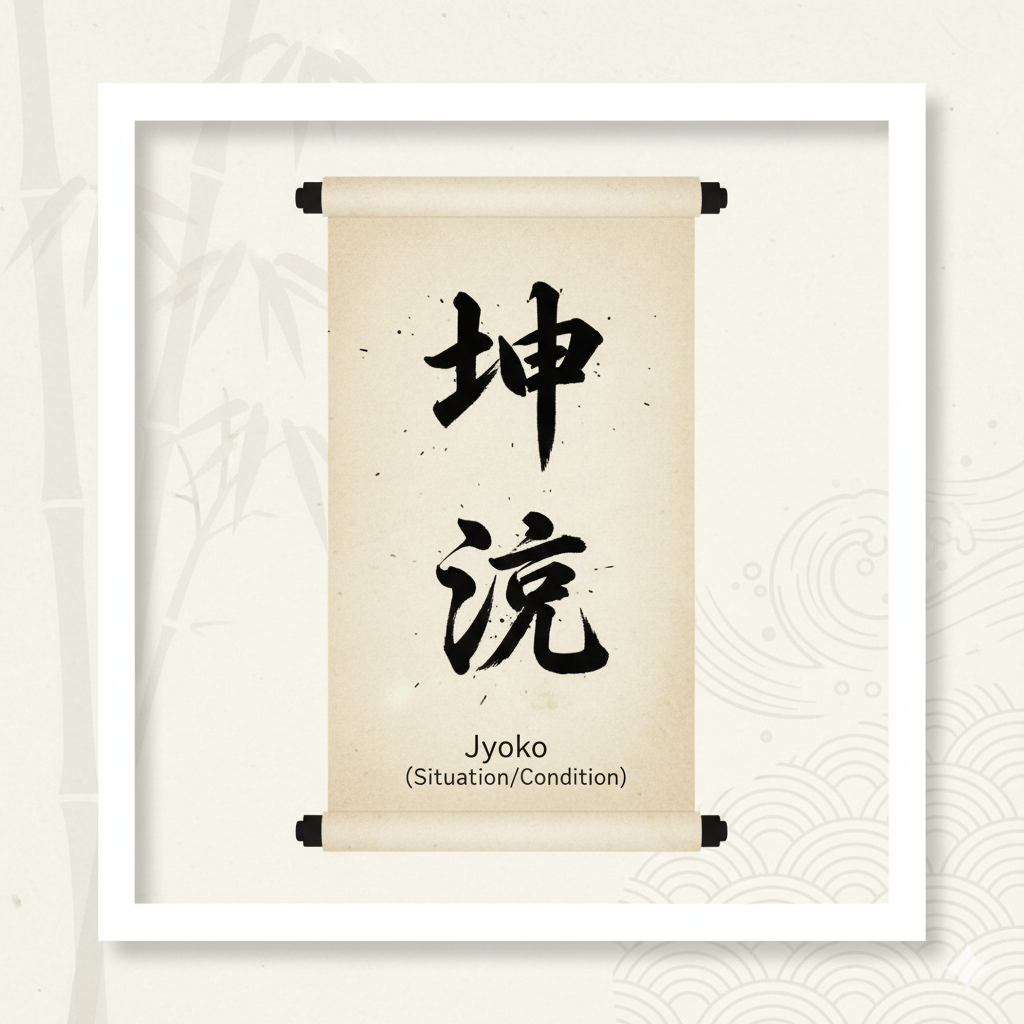
Jyokyo (状況) is a Japanese term that translates to “situation,” “circumstance,” or “state.” It goes beyond a simple description of events and instead reflects the overall context in which something occurs. In Japanese communication, where subtlety and indirect expression are highly valued, jyokyo is an essential word. It allows speakers to describe conditions in a way that gives room for interpretation and shared understanding without being overly direct.
The Roots and Linguistic Breakdown
The Japanese word jyokyo (状況) has its foundation in two kanji characters that together create a concept far more nuanced than a simple translation into English. The first character, 状 (jō), is often used to express a “state,” “form,” or “appearance.” It suggests the visible or external shape of something, how it presents itself to the observer. The second character, 況 (kyō), refers to “condition” or “circumstance,” focusing more on the underlying situation or environment that gives shape to an event. When these two kanji are combined, they create a powerful term that communicates both. The outward appearance and the contextual circumstances surrounding a situation.
This dual-layer meaning is essential because it reflects how the Japanese language often emphasizes context rather than just surface-level description. Unlike English words such as “event,” “incident,” or “happening. Which tend to isolate a moment in time, jyokyo includes the background and atmosphere in which events unfold. It is not only about what is happening but also why and under what conditions it takes place. For instance, describing the “economic jyokyo” doesn’t just highlight the numbers. It refers to the larger environment, the external factors, and the hidden influences shaping those numbers.
Everyday Use of Jyokyo in Japanese Life
In Japanese daily life, jyokyo is one of those versatile words that can naturally fit into a wide variety of conversations. It is used not only to describe personal circumstances but also to capture broader environmental or social conditions. For example, if a friend asks, “Anata no jyokyo wa dō desu ka?” (あなたの状況はどうですか?), the meaning extends beyond simply asking, “What’s going on?” Instead, it is an invitation for the person to share a more complete picture of their current situation, which may include health, work, studies, financial status, or even emotional well-being.
Because Japanese society values politeness and indirectness, jyokyo becomes a useful way to show concern without prying too deeply. Instead of asking a very direct question like “Are you sick?” or “Are you struggling at work?” a person might use jyokyo to allow the other speaker to answer at the level of detail they feel comfortable sharing. This indirect style makes communication smoother and maintains harmony, an essential part of Japanese interpersonal relationships.
Jyokyo in Business and Professional Contexts
In the professional world, jyokyo is an important term used to describe market conditions, project updates, or workplace challenges. A company report might include phrases such as “Keizai no jyokyo wa muzukashii” (The economic situation is difficult), showing how the term can summarize complex issues in a single word. Because Japanese corporate culture often emphasizes harmony, politeness, and indirect communication, jyokyo provides a neutral and respectful way to discuss challenges or setbacks without sounding confrontational.
Jyokyo in Education and Learning Environments
In schools and universities, jyokyo is often used by teachers, students, and administrators to discuss academic progress or learning conditions. For example, a teacher might refer to a student’s “gakushū no jyokyo” (学習の状況), meaning “learning situation,” to describe how well they are keeping up with studies. Similarly, students may use jyokyo when explaining their study environment at home, their exam preparation status, or even the challenges they face. This reflects the flexibility of the term, which can adapt to both individual and institutional contexts.
Cultural and Social Importance of Jyokyo
Beyond simple communication, jyokyo plays an important role in Japanese society and cultural expression. It reflects the value placed on awareness of context, a principle rooted deeply in traditions like harmony (wa) and indirect communication. For example, in literature or media, jyokyo may be used to set a mood or describe a character’s surroundings, allowing the reader to understand emotions indirectly. This reflects a broader cultural preference for suggestion, atmosphere, and subtlety rather than blunt statements.
Jyokyo in Literature and Media
Writers and journalists often use jyokyo to build atmosphere or to provide readers with a sense of emotional background. A novel may describe the “seikatsu no jyokyo” (生活の状況), meaning the “life situation” of a character, to hint at struggles or successes without directly spelling them out. In news media, jyokyo appears in reports about political affairs, economic changes, and natural disasters. It works as a concise and respectful way to present events while leaving room for interpretation, which fits Japan’s cultural preference for nuance in storytelling.
Jyokyo in Global Understanding of Japanese Communication
For non-Japanese learners, jyokyo is more than just a vocabulary word; it is a gateway to understanding Japanese communication styles. Unlike in English, where directness is often valued, Japanese tends to highlight context, environment, and shared awareness. By learning how jyokyo is used, language learners gain insight into how Japanese people approach relationships, business, and society. It becomes clear that the word is not only linguistic but also cultural, representing a worldview where situation shapes meaning just as much as words themselves.
Examples of Jyokyo in Sentences
- 現在の状況は安定しています。 (The current situation is stable.)
- 彼の健康の状況は改善しました。 (His health situation has improved.)
- 市場の状況を分析する必要があります。 (We need to analyze the market situation.)
- 旅行の状況によって計画を変えました。 (We changed the plan depending on the travel situation.)
- 天候の状況が悪化しています。 (The weather situation is worsening.)
Conclusion
Jyokyo is more than just a word for “situation.” It embodies the Japanese cultural emphasis on context, harmony, and subtlety in communication. Whether in casual conversation, business meetings, or literature, jyokyo provides a way to describe circumstances holistically. Understanding this term gives learners of Japanese not only a useful vocabulary word but also deeper insight. Into how Japanese society views relationships, communication, and the importance of shared awareness.